TL;DR: A chatbot answers questions. An agent gets things done. Agentic AI is an LLM wrapped in a loop — it reasons about a goal, calls real tools to act on it, checks what happened, and keeps going until the goal is actually met, not just discussed. This post walks through that loop end to end, using a real refund request as the running example.
Who is this for? Business owners and operations leads deciding whether "AI" can actually replace a manual, multi-step process — and technical readers who want the real mechanics, not the marketing version.
A chatbot answers. An agent acts.
Most businesses that ask for "a chatbot" are actually describing something closer to an agent. A visitor doesn't just want to know your refund policy — they want their refund issued. A customer doesn't just want your office hours — they want their appointment moved to Thursday. Answering the question is step one; agentic AI is what makes step two possible without a human doing it by hand.
A single LLM call is one shot: text goes in, text comes out. It cannot check an order, cannot update a calendar, cannot issue a refund. Agentic AI wraps that same model in a loop that lets it decide what to do, actually do it through a tool, look at what happened, and decide again — until the goal is met.
The agent loop, step by step
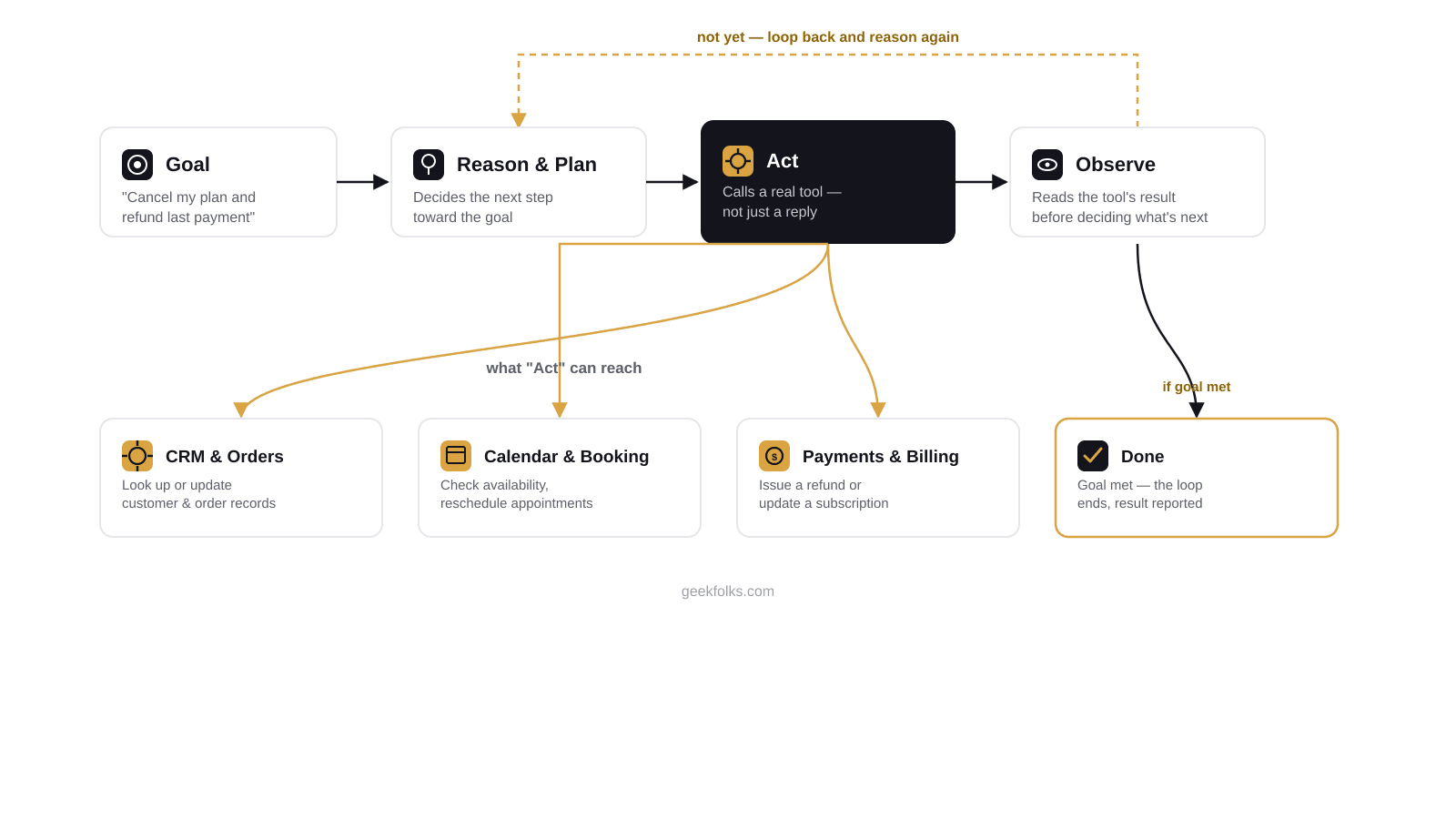
Walk through one real request: "Cancel my plan and refund my last payment."
- Goal. The request comes in as-is. Nothing is assumed about what needs to happen next.
- Reason & Plan. The model breaks the goal into steps: look up the subscription, confirm it's active, cancel it, then refund the most recent charge.
- Act. It calls a tool — a real function against your billing system — to look up the subscription. Not a guess. An actual API call.
- Observe. It reads the result: subscription is active, last charge was $49 on the 12th.
- Decide. Goal not met yet — two steps remain. Loop back to reasoning: cancel the subscription, then issue the refund, observing the result of each before moving on.
- Done. Once both actions succeed and are confirmed, the loop ends and the result — not just a description of it — is reported back.
The shape of that loop, with the tools a real agent reaches for along the way:
What makes this different from a chatbot
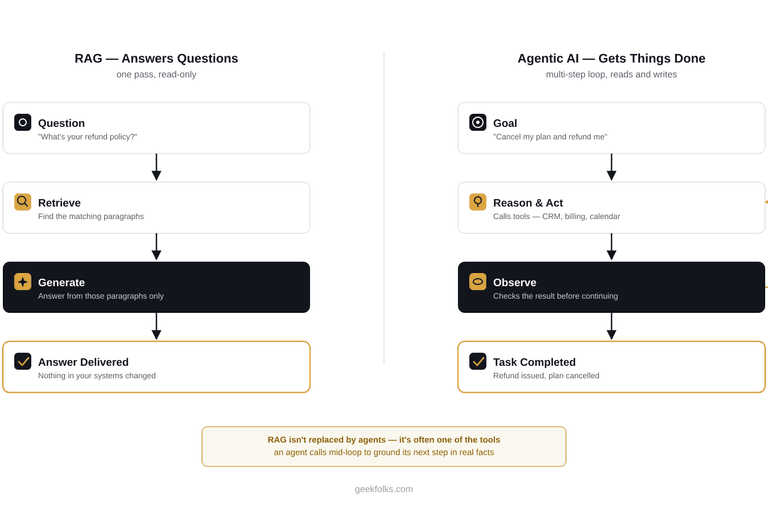
What a chatbot does
- Answers a question from what it knows or retrieves
- Every response is a single pass — no follow-through
- Worst case: it gives a wrong or unhelpful answer
What an agent does
- Pursues a goal across multiple steps
- Calls tools that read and write to real systems
- Worst case: it takes a wrong or unwanted action
That last line is the important one. A chatbot's mistake is a bad sentence. An agent's mistake can be a bad refund, a cancelled subscription that shouldn't have been, or an email sent to the wrong person. The upside is proportional to the risk — which is exactly why how you build one matters more than whether you build one.
What it takes to build one responsibly
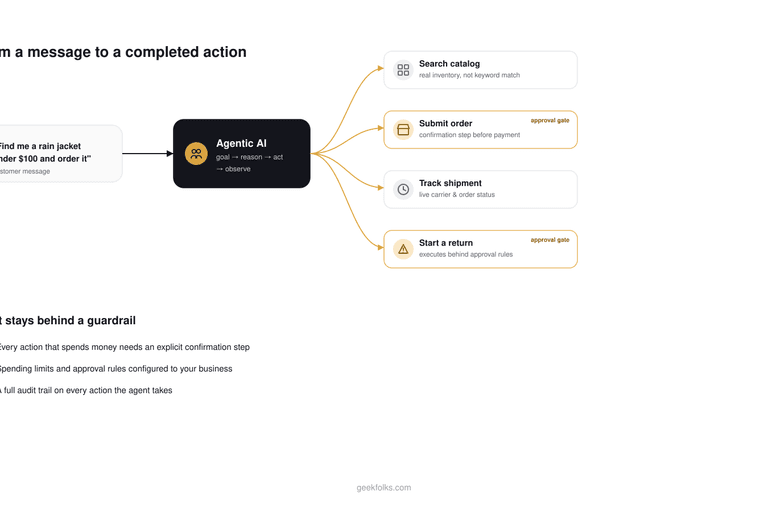
- Narrow, well-defined tools. Each tool the agent can call does one thing, validates its own inputs, and returns a clear result — not a wide-open "run this SQL" style function.
- Guardrails on consequential actions. Refunds over a threshold, cancellations, anything irreversible — gated behind an approval step or a hard limit, not left to the model's judgment alone.
- Memory that's scoped correctly. Short-term context for the current conversation, long-term state pulled from your actual systems — never invented.
- Full observability. Every reasoning step, every tool call, every result logged — so when something goes wrong, you can see exactly where and why, not just that it did.
- A defined exit. A maximum number of loop iterations and a clear human-handoff path for anything the agent isn't confident about.
Warning
An agent without guardrails isn't more capable — it's just a faster way to make an expensive mistake. The loop is the easy part; the approval gates, spending limits, and audit trail around it are what make it safe to point at production systems.
Where this actually pays off
The businesses that get the most from agentic AI are the ones automating a process that already has clear steps — just currently done by a person, by hand:
- Order & subscription management — cancellations, refunds, plan changes, resolved end to end.
- Appointment scheduling — checking real availability and rebooking without back-and-forth emails.
- Lead qualification — asking the right follow-up questions and updating the CRM automatically.
- Internal operations — invoice processing, ticket triage, routine approvals that follow a known pattern.
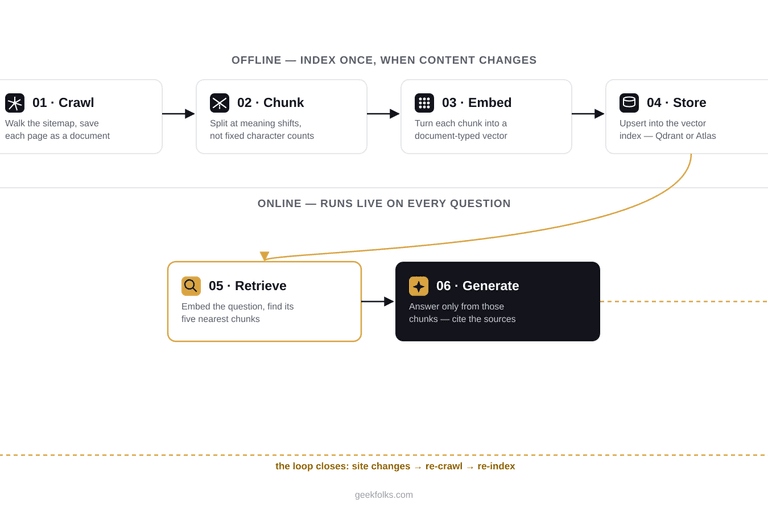
Each of these is a workflow, not a question. That's the tell for when a chatbot isn't enough and an agent is the right investment. Retrieval is often one of the tools an agent calls along the way too — see RAG vs Agentic AI for exactly when you need one, the other, or both, and The Retrieval Loop for how the retrieval half works.
We scope, build, and guardrail agentic systems like this for clients — from the first tool integration to production. If one of the workflows above sounds like yours, Agentic AI for E-Commerce and we'll walk through what it would actually take.