TL;DR: RAG answers questions from your data. Agentic AI takes multi-step action using your data. They solve different problems, carry different risks, and most real systems eventually need a mix of both — an agent that calls RAG as one of its tools. Picking the wrong one first is the most common way businesses overspend on an AI project.
Who is this for? Anyone who's been told they need "AI" and isn't sure which kind — before a proposal gets written or a budget gets committed.
Two very different jobs
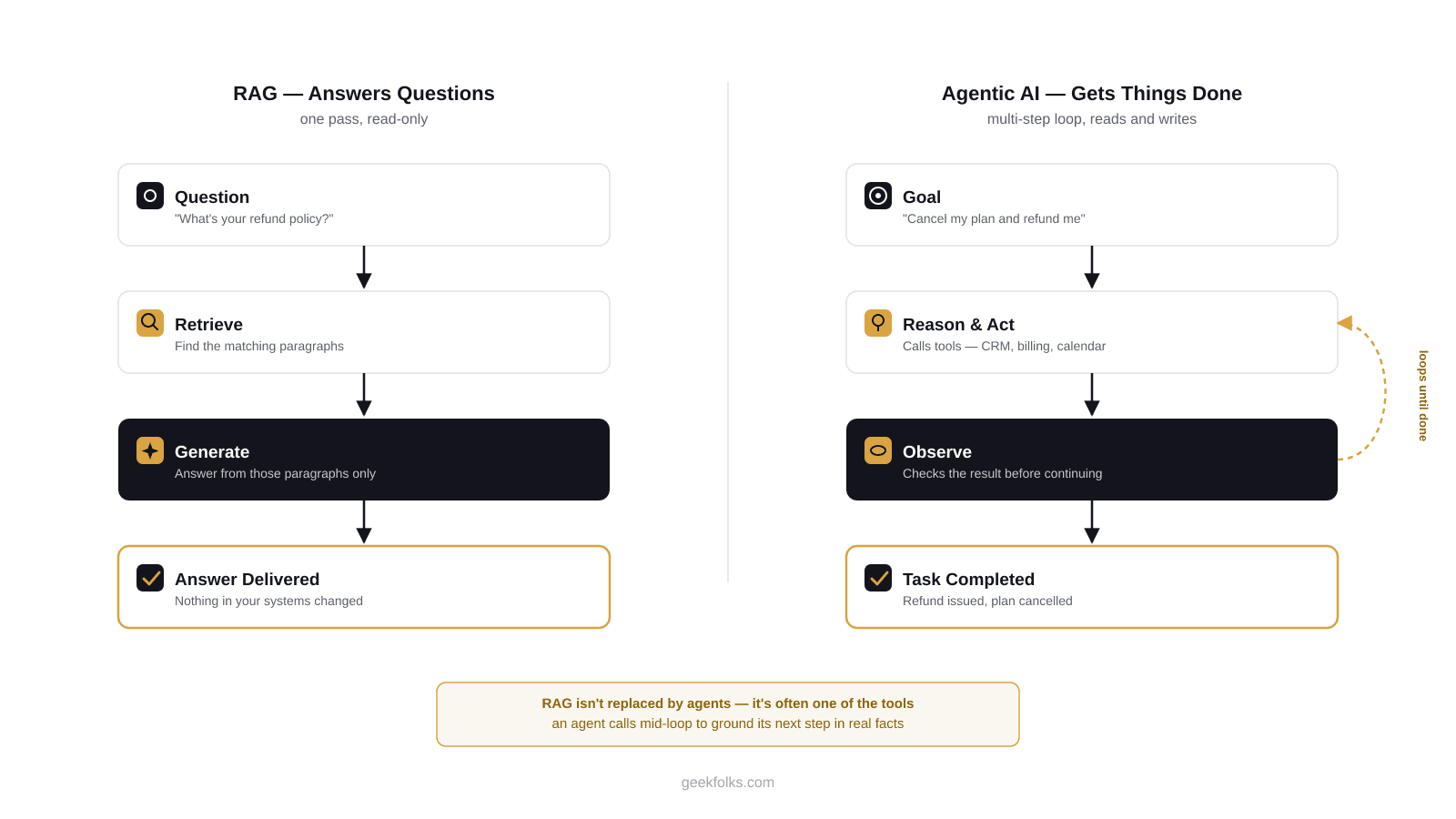
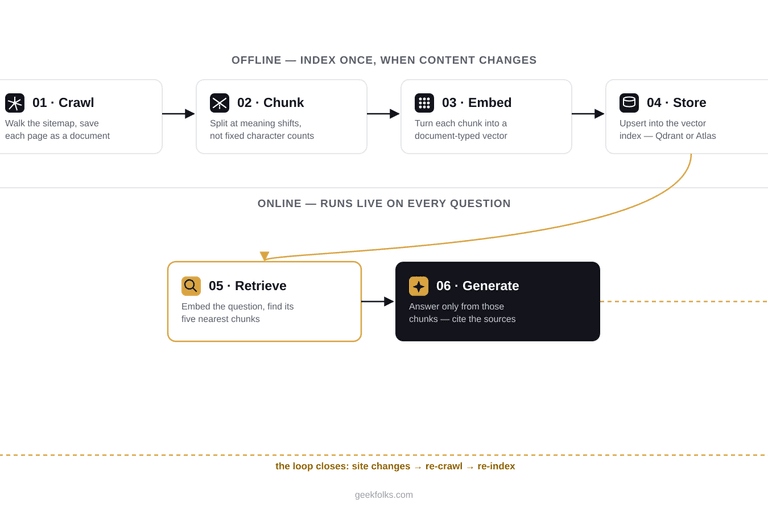
Retrieval-Augmented Generation (RAG) answers a question using your actual documents instead of the model's memory: retrieve the relevant paragraphs, hand them to the model, get a grounded answer back. It reads. It never writes. We covered exactly how this works, stage by stage, in The Retrieval Loop.
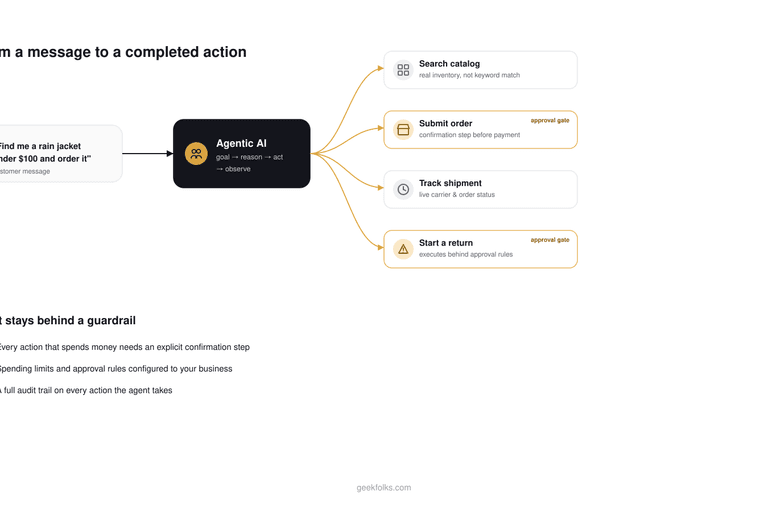
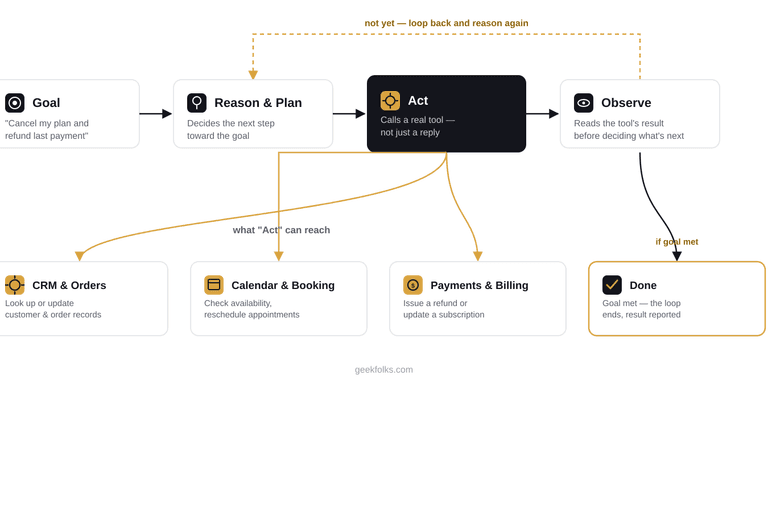
Agentic AI pursues a goal across multiple steps, calling real tools — CRM updates, refunds, bookings — and checking the result before deciding what to do next. It reads and writes. We broke that loop down in How Agentic AI Actually Works.
Confusing the two is the single most common reason an AI project either overshoots its budget or underdelivers on what the business actually needed.
Side by side
- Scope of action: RAG only reads. Agentic AI reads and writes to real systems.
- Predictability: RAG is a single deterministic pass. An agent's path can vary run to run based on what it observes.
- Worst case: A wrong RAG answer is a bad sentence. A wrong agent action is a bad refund, booking, or email.
- Latency & cost: RAG is one retrieval plus one generation. An agent may loop through several tool calls before finishing.
- What you have to log: RAG needs the retrieved sources. An agent needs the full decision trace — what it reasoned, what it called, what it observed.
When to reach for RAG
- A support bot answering from your docs, FAQs, and policies
- Internal knowledge search across scattered documentation
- Sales enablement — instant, accurate answers about product and pricing
- Anywhere the visitor just needs to know something, not have something done
When to reach for agentic AI
- Order, subscription, or refund management handled end to end
- Appointment scheduling and rescheduling against real calendars
- Lead qualification that updates the CRM as it goes
- Internal workflows — invoice processing, ticket triage — that follow a known multi-step pattern
The mistake we see most — and the fix
Businesses often ask for "an AI agent" when a well-grounded RAG chatbot would solve the actual problem for a fraction of the cost and risk. Just as often, they ask for "a chatbot" when what they're describing — cancel this, rebook that, refund me — genuinely requires an agent that can act.
The two aren't rivals, though. In most production systems we build, retrieval is just another tool the agent calls mid-loop: it reasons that it needs a fact, retrieves it from your knowledge base the same way a RAG system would, and uses that grounded answer to decide its next action. A support agent that looks up your refund window before deciding whether it's allowed to issue one is running both patterns at once.
Note
The decision heuristic in one line: if the answer is enough, build RAG. If the visitor needs something actually done, you need an agent — usually with RAG built in as one of its tools.
Getting this classification right before writing any code is most of the work — it's the difference between a system that pays for itself and one that's expensive shelfware. That scoping call is exactly where we start with every AI engagement. AI Website Chatbot and we'll tell you plainly which one — or which combination — your business actually needs.
We build both as productized offerings: AI Website Chatbot for RAG-grounded question answering, and Agentic AI for E-Commerce for product search, order submission, and order tracking as real actions.