TL;DR: Most point-of-sale systems stop at the transaction: a sale happens, a receipt prints, and the accounting consequences are left for someone to reconstruct later from an export. That gap — between when a sale happens and when it's actually reflected in your books — is where discrepancies, shrinkage, and pricing errors hide for weeks at a time.
Who is this for? Retail and hospitality operators, and the finance teams who close their books every month using data from a system that was never designed to talk to accounting.
The three-week lag that shouldn't exist
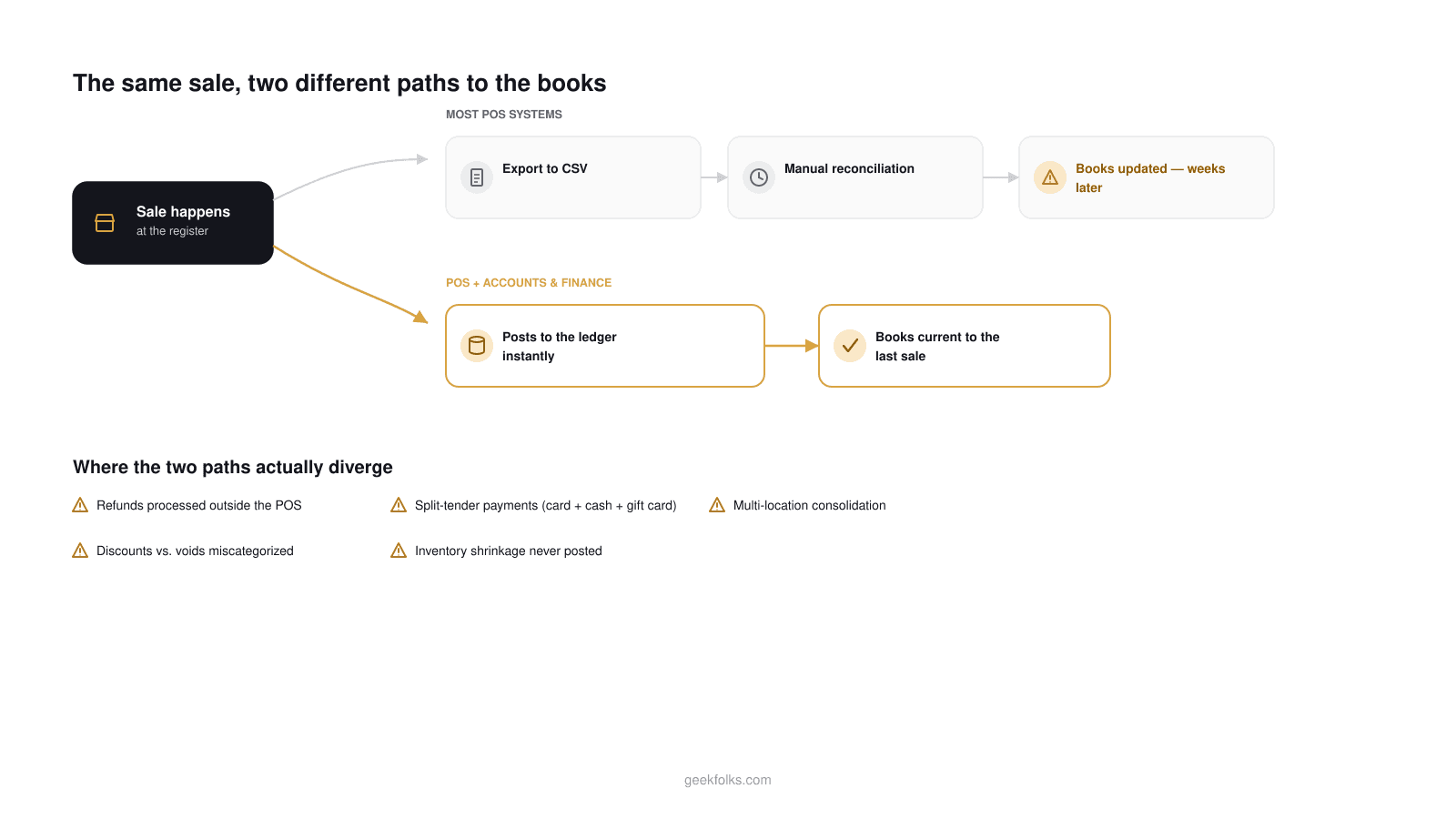
Ask most retail finance teams how current their books are, and the honest answer is "as of the last reconciliation," not "as of the last sale." POS data gets exported, mapped, cross-checked against bank settlement, and manually posted — a process that can run days or weeks behind the transactions it's describing. By the time a discrepancy surfaces, the register that caused it has processed thousands more sales.
Where the numbers actually diverge
- Refunds processed outside the POS. A refund issued through the payment processor directly never reaches the sales ledger, so revenue looks higher than it was.
- Split-tender payments. Part card, part cash, part gift card — many systems record this as one transaction type, losing the breakdown accounting actually needs.
- Multi-location consolidation. Each location's till closes clean on its own, but nothing rolls the group up into one ledger without a manual step.
- Discounts and voids miscategorized. A void looks identical to a discount in a lot of exports, and the difference matters for margin reporting.
- Inventory shrinkage never gets posted. Stock that's missing at count time has no accounting entry at all unless someone remembers to create one.
Important
Manual reconciliation doesn't just cost hours — it hides the underlying problem for as long as the lag lasts. Theft, pricing errors, and processor fee discrepancies are all easier to miss three weeks after the fact than three hours after it.
What a POS with a real accounting core does differently
The fix isn't a better export process — it's a point-of-sale system where every sale, refund, and payment posts directly to a double-entry ledger the moment it happens, instead of being reconstructed from a report later. That's the specific problem our POS + Accounts & Finance product is built to solve: P&L, balance sheet, and cash flow are generated straight from ledger data, current as of the last transaction rather than the last export, with tax liability and multi-location consolidation handled as configuration, not spreadsheet work.
When off-the-shelf accounting bolt-ons aren't enough
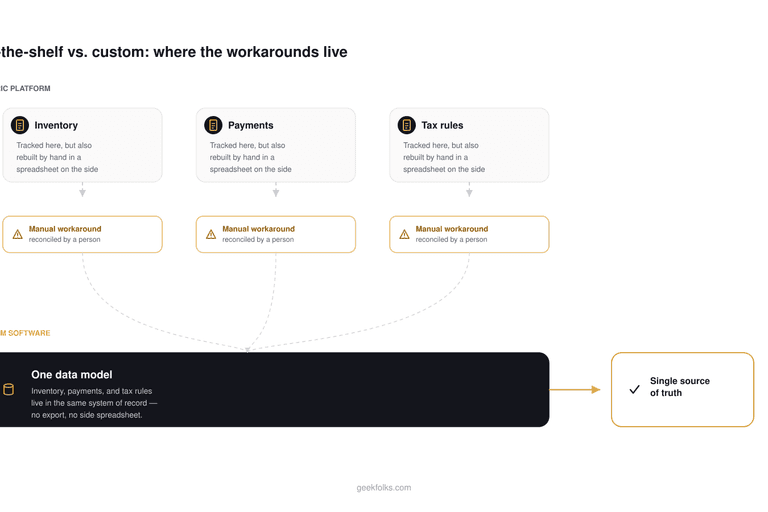
Some businesses have retail operations specific enough — consignment terms, franchise structures, industry-specific tax rules — that even a strong out-of-the-box POS needs real customization. That's custom software development territory rather than configuration, and it's worth reading the broader pattern in signs you've outgrown off-the-shelf software before committing to either path.
If you're running both a storefront and physical locations, inventory sync between the two is the next place numbers usually drift — see when a template storefront stops working for the e-commerce side of the same problem.
Curious what closing the month would look like with same-day numbers? Book a discovery call and we'll walk through your current reconciliation process and where it breaks.