TL;DR: Template storefronts are built around a simple product model: one SKU, one price, one warehouse. Once your catalog has real variant matrices, tiered B2B pricing, or multi-warehouse fulfilment, you stop building your store and start fighting the platform to express what your business actually does. That's the point to consider a headless commerce platform — not before.
Who is this for? Multi-brand retailers, B2B wholesalers, and direct-to-consumer brands that have scaled past what a theme-based storefront builder can express.
The one-SKU assumption
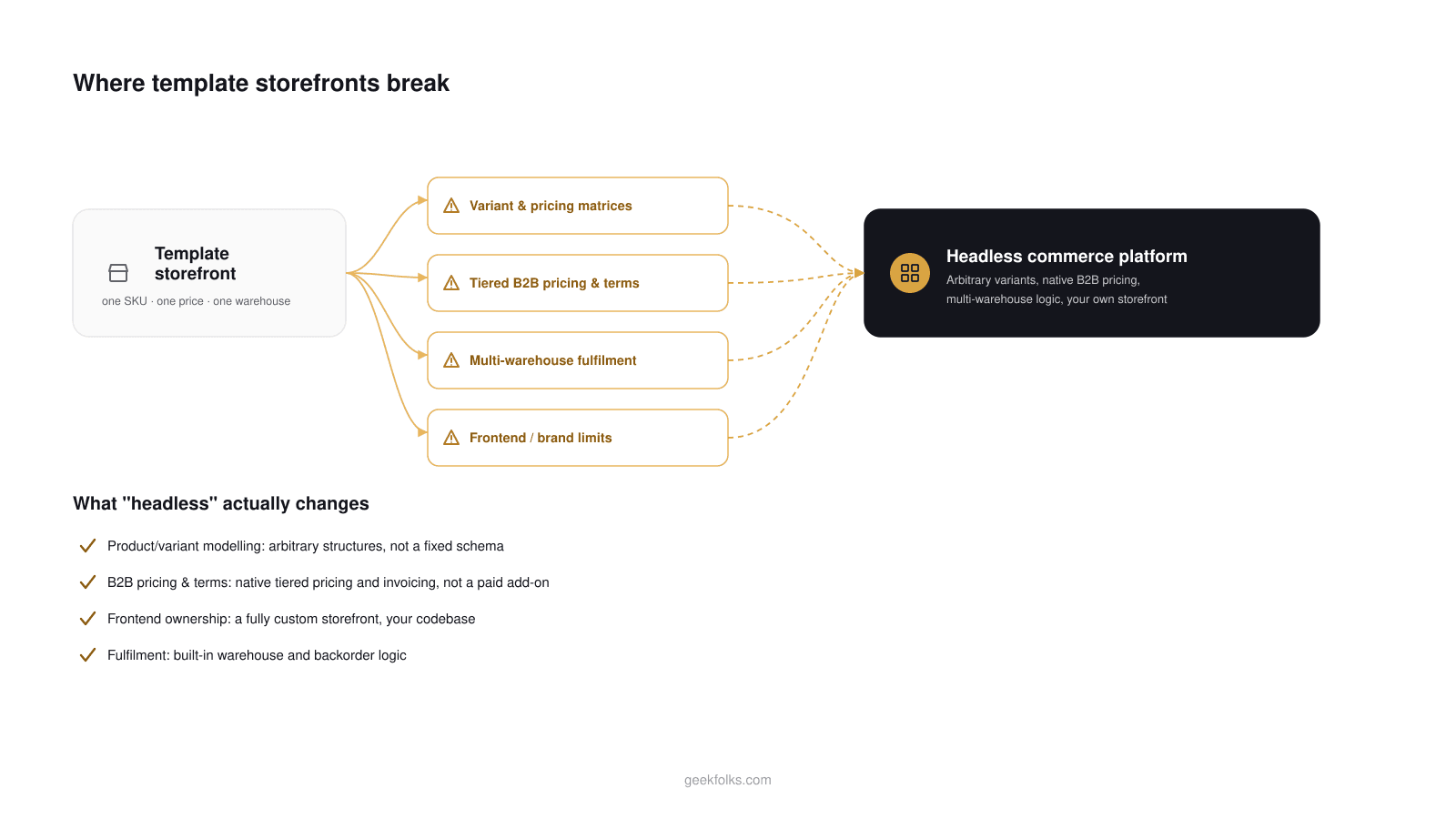
Every template platform, no matter how flexible it looks in a demo, encodes an assumption about how commerce works: one product, one price, one location, sold to one kind of customer. That assumption is invisible when it's true for your business, and it's the wall you hit the moment it stops being true — usually right as the business is growing fastest.
- Variant and pricing matrices. Size, color, material, and grade combinations with different prices per combination — most themes can express one or two variant dimensions before the data model gives out.
- Tiered B2B pricing and terms. Different prices by customer tier, net-30 invoicing instead of card-on-file checkout — usually a paid add-on if it's available at all, bolted on rather than native.
- Multi-warehouse fulfilment. Routing an order to the right warehouse, splitting a single order across two, and handling backorders correctly needs logic most storefront builders never had to solve.
- Frontend ownership. Once your brand needs an experience the theme marketplace doesn't offer, you're either paying for expensive custom theme development inside someone else's constraints, or you're stuck.
Note
None of this means headless is automatically the right call for every growing store. If your catalog genuinely fits the one-SKU model, a template platform is still the faster, cheaper choice — the signal to switch is the actual shape of your catalog, not the size of your revenue.
What headless actually buys you
"Headless" means the commerce logic — catalog, pricing, inventory, orders — lives behind a documented API, and the storefront is built to your brand rather than assembled from a theme marketplace. That's the model behind our e-commerce platform: arbitrary variant and pricing structures, native tiered B2B pricing and invoicing, and built-in multi-warehouse and backorder logic, with a storefront your team fully owns instead of one constrained by a shared theme runtime.
Migrating without a big-bang rewrite
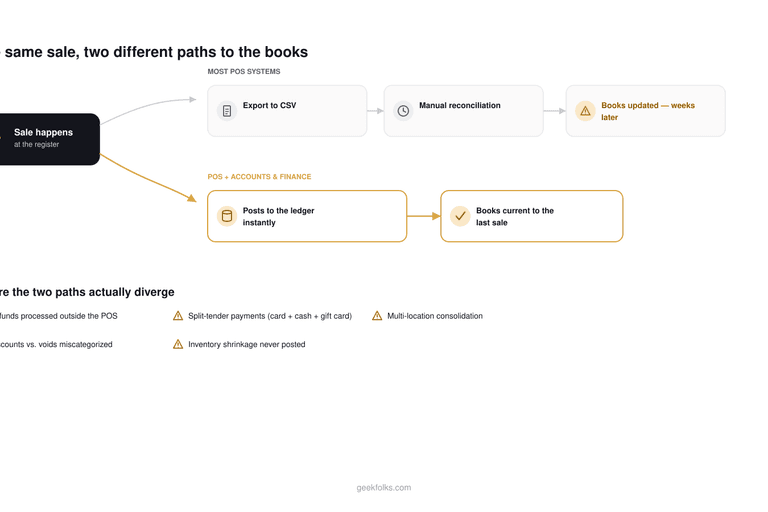
A full platform migration doesn't have to happen in one release. The API-first design means a new storefront can be built and validated against real data before cutover, and for businesses running physical locations alongside online sales, inventory and order sync between channels is a native integration rather than a middleware project — the same problem covered from the POS side in why your POS numbers never match your books.
If the catalog complexity is a symptom of a broader pattern — manual workarounds across several systems, not just the storefront — it's worth reading signs you've outgrown off-the-shelf software for the wider picture.
Not sure whether your catalog has actually outgrown a template platform? Book a discovery call — we'll look at your product model honestly before recommending a rebuild.